


AMRC and WMG map the future of e-machine circularity
Published: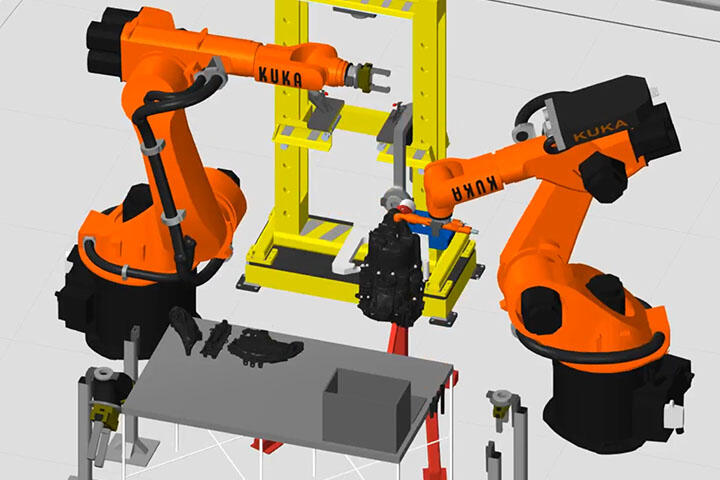
- The rapid adoption of electric vehicles (EVs) creates an urgent global challenge: how to sustainably process millions of high-value electric motors (EMs) at the end of their life.
- To address this, a cross-Catapult collaboration led by Warwick Manufacturing Group at the University of Warwick alongside the University of Sheffield AMRC has created a detailed digital disassembly map and simulation tool.
- This work delivers immediate impact by drastically mitigating technical bottlenecks, paving the way for circular economy (CE) pathways and enabling the recovery of value-embedded components and materials, such as rare earth magnets, electrical steel, copper and aluminium, from end-of-life (EoL) e-machines.
Challenge
Disassembling complex EoL e-machine units efficiently with minimal to no damage to retrieve high-value components for reuse, remanufacturing and recycling is a significant challenge. By design, these machines are highly integrated using unique manufacturing techniques, thereby making the recovery of components and materials through manual approach, a technically challenging and time-consuming process.
The challenge was to turn a complex, manual and carbon-intensive activity into an automated and minimally destructive process to unlock the maximum potential value from retrieved components and materials, while reducing the laborious nature of manual disassembly, both in terms of time and technical complexity.
Background
The global transition to electric mobility is heavily reliant on Rare Earth Elements (REEs), particularly those used in permanent magnets (PMs) within e-machines, which are subject to high price volatility and geopolitical supply risks. In addition, there is often considerable environmental damage incurred in mining virgin REEs, thus making a high rate of REE recovery essential for a sustainable e-machine supply chain.
Currently, EoL e-machines are often shredded through mechanical means and shipped overseas for manual disassembly, where labour costs are lower. The former results in material loss and impurities during the shredding process since they stick to process units and eventually end up in various material streams in a very diluted form. Being able to automate the disassembly of EoL e-machine units, would not only unburden high operational costs associated with manual approaches, but would also facilitate the maximal recovery of these critical materials needed to build onshore resilience within the UK.
Innovation
AMRC and WMG, leveraging their respective expertise as members of the High Value Manufacturing (HVM) Catapult network, formed a collaboration with WMG as the lead partner on the Catapult-funded project, A Circular Economy Approach for Recycling Electric Motors in End-of-the-Life Vehicles (RECYCEM).
- Manual deconstruction for digital insight: WMG's initial work involved the careful manual disassembly of a typical (EM) from an EoL EV. This hands-on process allowed the WMG team to capture crucial, real-world data on the component architecture, material connections and sequence steps required for component separation.
- Digital disassembly mapping: This physical knowledge-based process was translated into a comprehensive digital disassembly map by the AMRC using its experience in automated teardowns. This map identifies the least disruptive sequence to recover key materials, focusing on techniques that avoid damaging components, which is a vital pre-requisite for high-value remanufacturing, reuse and recycling pathways.
- Simulation and roadmap for automation: AMRC and the WMG then utilised this map to develop a sophisticated simulation and automated process. This showcased how robotics could be programmed to execute the disassembly process, particularly demanding and challenging steps such as the separation of rotor-core which contained PMs, from the stator.
Result
This critical digital work was completed in an intensive one-month turnaround. It demonstrated that automation when supported by the process sequence and custom tooling, can drastically reduce disassembly timeframe from hours to minutes while preserving component integrity.
The project successfully created the first-stage digital blueprint (simulation and roadmap) for automated, minimally disruptive disassembly of EoL e-machines for high-value components and materials recovery.
As a result of this collaboration, the AMRC was able to apply WMG's expertise in e-machines, materials science and disassembly to find a way to automate the processing of EoL e-machines for recycling and remanufacturing, thereby pushing the technology towards application in real-world scenarios.
Impact
This foundational project has delivered a crucial step towards establishing CE pathways for EoL EV powertrain components in the UK, creating a blueprint for the future of automated EoL processing.
By developing a strategy to onshore high-value recycling in the UK, this work removes the need to ship e-machines overseas for manual and time-consuming disassembly, creating a secure, lower-carbon domestic material supply.
It provides a clear methodology for retrieving high-value materials, such as rare earth magnets, electrical steel, copper and aluminium, that can be fed directly back into secondary recycling processes, and in turn, the wider UK manufacturing industry, thereby enhancing resource security and supply chain resilience.