
Helping a design startup turn their manufacturing time from 2.5 days into 2.5 hours
Published: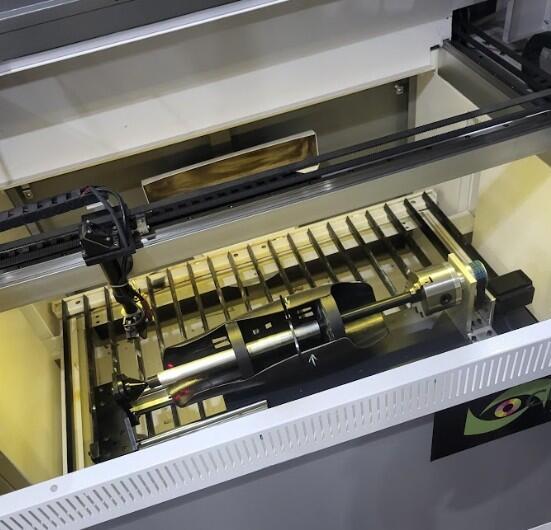
Challenge
To help a prosthetic leg cover manufacturer find a machine to speed up and automate their process.
Background
In 2017, former Paralympic medallist Mark Williams was stopped in a shop by a small child who told him how cool his leg looked. He had built himself a bright green cover for his prosthetic leg, complete with flashing LED lights. The experience inspired him to start a business making patterned covers for prosthetic legs, so other people could benefit from the added confidence of wearing such a cover.
The company — called Limb-Art and based in Conwy, North Wales — uses injection moulding to manufacture the covers, which are then cut down to the right size. Across four different styles there are a total of eight different sizes available, and Mark was manually cutting each cover down himself.
This was far from ideal. It was time-consuming, taking up time which could be spent doing more valuable work as the CEO of the company. It was imprecise, leading to minor variations in each product. And using an old-fashioned hand process meant he was reluctant to delegate the task to other members of staff due to health and safety concerns.
Mark had looked into using automated tools before, but the costs were prohibitive. Orders were pouring in and the business was growing. He needed to find a cutting solution to keep up with this growth.
Innovation
In 2024, Mark attended an SME engagement workshop at the University of Sheffield Advanced Manufacturing Research Centre Cymru (AMRC Cymru). These one-to-one meetings are for small and medium-sized businesses who may have challenges that are stopping them from taking the next step. The workshops are attended by an AMRC engineer and a representative from Business Wales, giving a rounded view of the help available.
Mark explained his desire for an efficient cutting solution that wouldn't require extensive capital investments, and AMRC Cymru agreed to conduct a five-day study to look at it. After visiting Mark’s workshop to analyse his process, an engineer conducted a desktop study into alternative processes that could be used, from basic jigging and fixtures all the way through to semi-automated and fully automated options.
AMRC Cymru presented Mark with a comprehensive report comparing each option based on his budget, key performance indicators and lean principles. This report built a business case to change his approach to cutting the leg covers.
Result
AMRC Cymru suggested a series of different solutions, from a low-cost interim process to a more complex one that could be set up later.
It also listed 15 or 20 different machines that could do the job, with pros and cons for each one, and potential suppliers. One of these was a UK company that Mark hadn’t been aware of. He got in touch with them and began testing his products on their machine.
Impact
Before this project, Mark was in a familiar position for a CEO of a startup — his business was growing, but as the person in charge he didn’t have the time to research new ways of manufacturing that could increase his capacity accordingly.
With their extensive industry knowledge and experience, AMRC Cymru’s engineers were able to provide solutions in five days that would have taken Mark months — leaving Mark time to concentrate on making leg covers for his customers.
Limb-Art installed a laser cutting machine in 2025. It can do the work which previously took Mark two and a half days in just two and a half hours. Alongside the time saving, the machine provides improved quality, safer operations, reliable results every time and the possibility for additional customisation.
As a result of the project, Mark’s business looks set to go from strength to strength.