


Helping a materials start-up take its groundbreaking new composite to market
Published: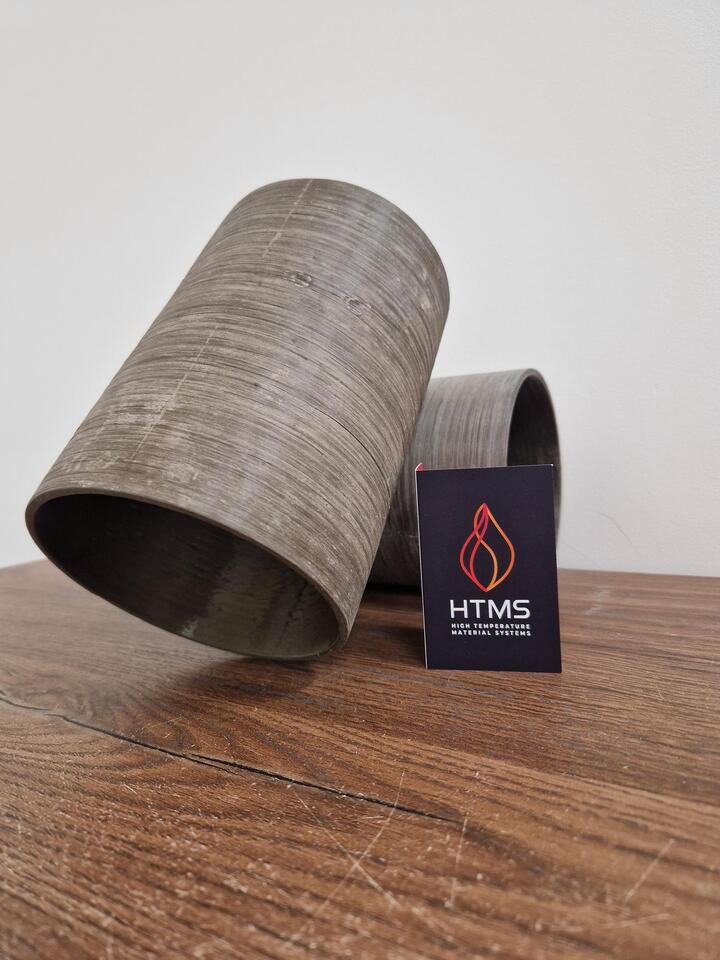
Challenge
Enabling a materials company to take its product to market by automating production of its innovative ceramic matrix composites.
Background
Ceramic matrix composites (CMCs) are a specialist material with a wide range of industrial uses, from motorsport to aerospace. They are typically very expensive and there is currently no supply chain in the UK, forcing British businesses to import them.
High Temperature Material Systems (HTMS) is a company founded in 2021 by Dr Danilo Di Salvo and Dr Richard Grainger to produce innovative CMCs for the UK’s manufacturing sector.
From their laboratory in Bristol, the company’s engineers have been developing new composites which combine the heat-resistant properties of ceramics with fibres for added strength and flexibility. This has the potential to transform this area of high-value manufacturing, lowering costs and introducing a UK-based supply chain for the first time.
After working on small trials with industry partners — including some Formula 1 teams — HTMS wanted to see if its new material could be made on a large scale using an automated process, with equipment already available to purchase.
Co-founder Richard had previously worked with the University of Sheffield Advanced Manufacturing Research Centre (AMRC), so he knew it had the state-of-the-art capabilities needed to test his new product. He approached its composites team for help.
Innovation
HTMS brought a selection of its new materials to the AMRC’s facility in South Yorkshire, and the AMRC’s engineers trialled these, assessing how they performed during the manufacturing process, before selecting two to manufacture a demonstrator component.
A trial was undertaken to see if the composites could be produced by wet winding, an automated process where fibres are dipped in a bath of slurry before going in a vacuum oven to green-state cure the ceramics. Engineers used the AMRC’s robotic filament winder to combine the ceramic matrix with continuous fibres. Previously, HTMS was applying slurry onto the fibres by hand, so using this machine saved a lot of time and improved the quality and consistency of the materials made.
The engineers analysed the process and gave HTMS information on how the materials behaved during the process and how to tweak various elements, such as the material viscosity.
Result
As a result of the trials, the AMRC engineers produced some carbon reinforced CMC tubes that HTMS could use to showcase its materials to potential customers.
But this was just the start.
The AMRC then worked with HTMS to apply for funding for research, resulting in a further five-month project looking at different ways of manufacturing its new material. This included tape manufacture, which could be explored further in 2026 when the AMRC acquires the UK’s first open-access, hybrid fibre reinforced thermoplastic tape development capability.
The trials have shown that the composites can be made with off-the-shelf fibres, opening up opportunities for many industrial applications and providing a lower-cost alternative to existing CMCs.
Impact
This work is all about giving HTMS a route to market for its product. By using the AMRC’s high-value manufacturing facilities, the company can refine and develop their material, and eventually move from batch production to full-scale manufacturing.
This would make a big difference to the high-value manufacturing sector, introducing a British-based supply chain for ceramic tape composites. The impact would be felt throughout the industry, creating jobs and the opportunity for components to be made much more cheaply.
By providing both engineering expertise and help with funding applications, the AMRC is setting HTMS on a path to a bright future.