
Helping an AI startup make waves in the marine renewables sector
Published: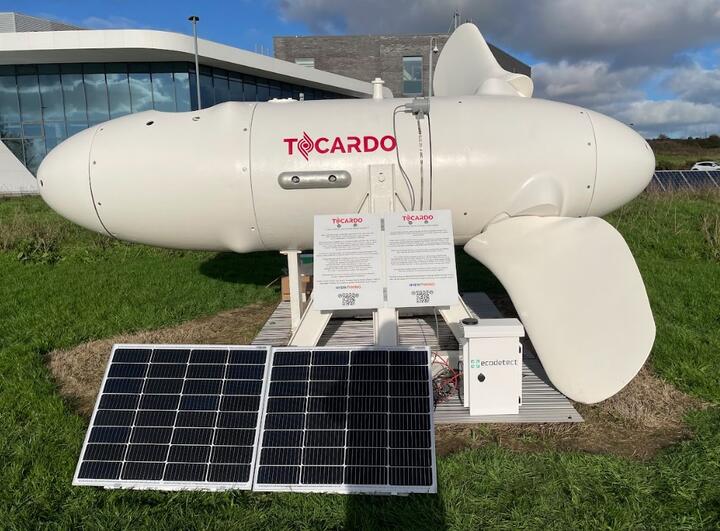
Challenge
To conduct a feasibility study for a tech startup, developing a new product with the power to process camera footage on marine infrastructure in real time.
Background
Ecodetect is a tech startup working in the marine renewable energy sector. It uses AI to monitor and classify marine life from offshore energy infrastructure camera footage.
In the drive for cleaner energy, renewables providers are increasingly looking to the sea — through technologies like tidal stream, wave energy and floating offshore wind farms. But ecologists have concerns about the impact of this infrastructure on marine wildlife.
Through increased demand, off-shore renewable companies require wildlife monitoring capabilities to report the impact of defined species around their infrastructure. This is done by mounting cameras on infrastructure like wind turbines. The cameras are motion-triggered to film any time something comes into contact with them, but the vast majority is from seaweed, algae and litter. This leaves thousands of hours of footage and many terabytes of data to comb through in order to record the wildlife encounters.
The Ecodetect team developed an AI algorithm to filter the footage and only capture the wildlife encounters required — saving significant time and money. But the camera still needed potentially dangerous manual retrieval at sea, with the footage then processed off-site. They wanted to see if it was possible to develop a machine that classifies the footage in real time at or near the location of the recording, vastly reducing the amount of data needed.
Innovation
The AMRC Cymru has significant expertise in edge AI technology — combining physical hardware with the processing power to run AI algorithms, performing operations in real time.
Ecodetect founder David Gold collaborated with an AMRC Cymru engineer to look into using this technology for the purposes of marine wildlife monitoring.The engineer studied David’s AI code, before conducting wide-ranging academic research and a market study to find hardware that could be used in a marine environment.
One of the AMRC’s biggest strengths is its breadth of experience, allowing its engineers to translate learnings from one sector to another. In this case, that meant taking some previous work on edge processing that was carried out for the food sector. Could the same technology which enabled machines to count items be moved from the factory to the ocean?
Result
The AMRC Cymru presented David with an action plan — a detailed roadmap showing how Ecodetect can deploy its algorithms on a device at sea.
It included information on the edge-to-cloud architecture needed, and what stages the company would have to go through to make it a reality — from testing to hardware.
In a specialist field like AI, this kind of information is invaluable. The project increased Ecodetect’s knowledge and provided the serious thinking needed to take the business to the next level.
Impact
Ecodetect is using the AMRC Cymru’s research to develop its product further. Thanks to the work done, David can show that due diligence has been carried out by a trusted research organisation, which greatly increases reliability and confidence in the product.
It’s an example of the AMRC’s ability to get new companies off the ground — making sense of uncertainty, bringing them up to date with market and technology trends, and presenting a clear roadmap for the future.
Ecodetect has now implemented the results of this work through the development and sea trial testing of a prototype, which has taken them a step closer to bringing a new product to the market.
Ecodetect has also benefited from the AMRC Cymru’s vast network of businesses and technology providers, allowing it to source suppliers for the hardware it needed to build the new device.
Ultimately this work could make it easier for renewables companies to monitor how their infrastructure interacts with wildlife — ensuring the health of our oceans while powering the future of sustainable energy.