


AMRC acts as a ‘toyshop for businesses’
Published: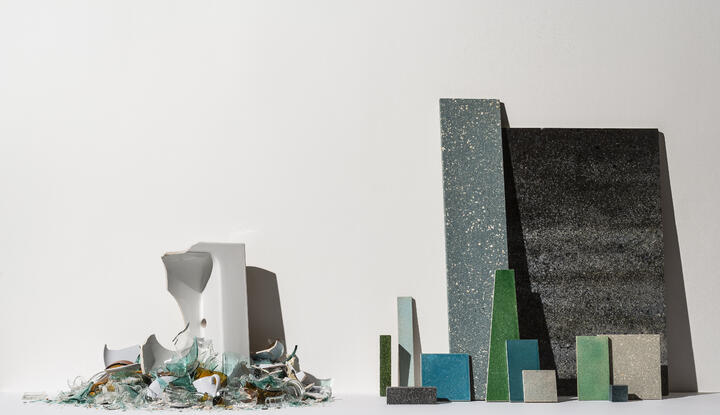
Early-stage trials on new pressing techniques by University of Sheffield Advanced Manufacturing Research Centre (AMRC) engineers have helped a company that makes sustainable tiles, tabletops and wallcoverings to avoid ‘unnecessary spending on research that wasn’t going to work’ by testing their ideas before investing in new equipment.
Alusid, a company which started life as a research project at the University of Central Lancashire, specialises in taking unwanted manufacturing materials destined for landfill and putting them through an environmentally low-impact process which results in a new kind of material, combining glass and porcelain, to create solid surfaces and tiles.
The Preston-based company wanted to investigate novel ways of producing large, recycled tiles at a lower pressure and using more cost-effective equipment. They approached the University of Sheffield AMRC for help to test their theories.
Dr Alasdair Bremner, Chief Executive of Alusid, said: “We worked with the AMRC on a proof-of-concept project and this was the only place in the UK we could have done these trials. Ultimately, this wasn’t an area of development we were able to take forward but running early-stage trials with the AMRC prevented unnecessary spending on research that wasn’t going to work for us.”
The AMRC, as part of the High Value Manufacturing (HVM) Catapult, supports businesses to try out and de-risk technology and equipment they wouldn’t otherwise have access to. The project was paid for using funds from the HVM Catapult as part of a commitment to working with small and medium-sized enterprises.
Darren Wells, Technical Lead at the AMRC, said: "Our work with Alusid was about supporting them to use our equipment to test theories they had already devised themselves. They wanted to produce tiles and surfaces of larger sizes and different shapes, and needed access to specialist equipment to test their ideas before making the substantial investment of purchasing their own press. We supported them through three rounds of trials.
"In this way, the AMRC helped them explore the art of the possible. In cases like this, we can act as a sort of toyshop for businesses who want to try out equipment and techniques they wouldn't otherwise have access to."
After a series of trials on AMRC equipment, Alusid concluded this approach would not make financial sense for them to pursue and are currently developing alternative methods. Dr Bremner added: “Not every concept is going to be feasible, and the point is you have to do the experiments to know.”