


Timing, tenacity and talent: the next generation of nuclear
Published: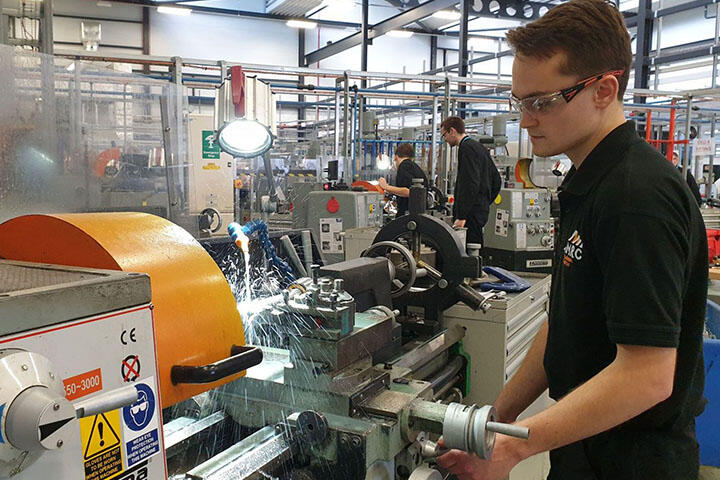
Sean Delaney had just finished his A Levels when a chance encounter in a pub changed the trajectory of his life.
Much like the AMRC’s bright and humble beginnings, Sean’s journey started when he met Adrian Allen. Sean’s friends had spoken of Allen’s work forming the AMRC, and he wanted to know more. After spotting him whilst out, Sean introduced himself and explained his interest in engineering, and desire to see what was behind the doors of the ominously large AMRC buildings over in Rotherham.
“When I met Adrian, I told him I wanted to be an engineer and asked if he had any advice,” said Sean.
Allen had more than advice: he offered Sean a tour of the AMRC facilities the very next week and, in a moment of fortuitous timing, mentioned how one of its technology groups was recruiting apprentices through the AMRC Training Centre. Sean applied, soon starting his three-year machining apprenticeship.
“I don’t come from an engineering background. My dad worked down a mine, which wasn’t manufacturing but is still embedded in that South Yorkshire culture,” said Sean.
“I did my A Levels but I didn’t enjoy them. I could have gone to university, but I took the decision to start from the beginning again with a secure job. By the time I finish my education, I’ll have got my degree five years later than I would have with a university route, but with secure employment, without the debt, whilst learning along the way, and with work opportunities. It was a trade off, but it came with a lot more opportunities than drawbacks.”
From there, Sean moved from stepping stone to stepping stone, with a hop over to the AMRC’s integrated manufacturing group (IMG) for a Level 4 Higher National Certificate (HNC), where his strong skillset and capabilities shone through, resulting in his being drafted to work on IMG’s Rolls-Royce small modular reactor (SMR) project portfolio, where he is also working towards his degree apprenticeship.
It feels like I’m getting to the point where I could do anything. I can stand on my own two feet as an engineer. I can increasingly point back to things over the past seven years that I can be proud of.
“My Level 3 apprenticeship was almost exclusively machining, before taking on more responsibilities around structural testing – not just making parts, but helping assemble them into something we could use to test different components,” said Sean.
“It was a little bit out of character for me to move into robotics; it wasn’t something I’d ever imagined doing. It turned out, in an odd way, that though I moved to IMG expecting to do what it’s known for - robotics - instead I’m dealing with large assemblies.”
Sean’s move into large assemblies was no accident; he was spotted by the IMG team because of the traditional manufacturing skills he’d developed such as assembly and working with cranes.
“I could never have imagined my career was heading in this direction,” he added. “In a way, I’ve gotten really lucky. I’ve always been interested in civil engineering, nuclear power and in the more traditional manufacturing, and now my work with small modular reactors (SMR) is where all those three combine.
“The scale of it is interesting in itself; the assemblies are massive - they can weigh ten tonnes or more - but also the impact of the work I’m doing for UK industry and the clean energy sector.”
His work is part of the ongoing partnership between Rolls-Royce SMR and the AMRC, helping to deliver a factory-built nuclear power station to meet the world's future sustainable energy needs.
Sean said: “The first SMR project I worked on was proving that we could use skids to accelerate the manufacturing of the modules - each module will have assembly inside of it, but thousands of these modules are going to be built - if that assembly can be built elsewhere on a metal frame, then put into the module, we’d improve the efficiency of the manufacturing massively.
“The second one we’ve just completed focuses not on what’s inside the modules, but how they interact with each other.
“We take two different modules, with two different meeting points inside them – for example two pipes – and those modules have to be joined together, but those pipes also have to meet. Then the modules have to stack together.
“It sounds basic, that one of the big challenges is ‘can these be stacked on top of each other with what’s assembled inside meeting?’, but no one’s really done it before, and it’s got to be done eventually; you can’t leave it until the final design and then hope it all comes together in the end.”
The AMRC’s SMR project team hasn't stopped noticing Sean’s work since; he won a University of Sheffield inspirational technician award after being nominated by his line manager, Mike Portnell, who said Sean's drive to improve and develop has been outstanding, and hasn’t gone unnoticed by the team or the customer.
For Sean, the award symbolised a moment of reflection. He said: “It feels like I’m getting to the point where I could do anything. I can stand on my own two feet as an engineer. I can increasingly point back to things over the past seven years that I can be proud of - things that I’ve worked on, different qualifications I’ve achieved. It gave me an excuse to look back and see how far I’ve come.
“I’ve been lucky. Other people would describe it more generously, but for me, I’d say I’ve had three pieces of good luck: meeting Adrian Allen, getting into IMG, and being invited onto the Rolls-Royce SMR project. Those are my three stepping stones, which have come alongside my educational stepping stones.”
To everyone else around him, Sean is too humble: all three of those steps were steps he took himself. Not luck, but bravery and boldness; finding an opportunity and going for it.
As for his advice to anyone trying to find their own pathway, this is what he said: “If you don’t know what to do, get out there and see what there is to be done.”