


Hitting the ground running
Published: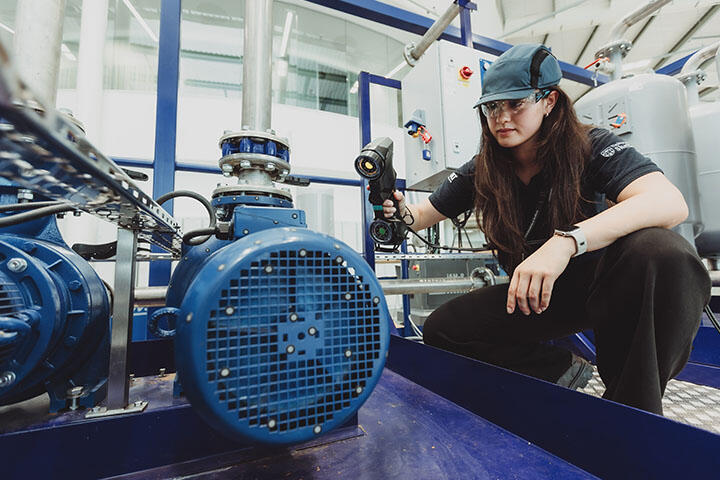
Kim Butterfield joined the AMRC at a sprint. In the span of one year, she started a week of work placement, a summer placement, and a full-time role, all during and following the final year of her degree.
Soon after starting her full-time role, Kim was tasked with working on the Rolls-Royce Small Modular Reactor (SMR) project, EXPERI – Rolls-Royce SMR’s prototype module manufacture and test facility housed in the AMRC’s Factory 2050.
To meet demand, Rolls-Royce SMR nuclear plants will be built in parts, constructed using transportable modules that are manufactured and tested in off-site factories – modularisation. This allows the plants to become operational quicker than conventional nuclear plants, as well as reducing cost and uncertainty for developers.
Working with the automated assembly team, Kim helped the build process by aligning component placement, and verifying components were manufactured to their design specification. By proving out the manufacture, this work is de-risking delivery; moving Rolls-Royce SMR from design and prototype manufacture to full modular assembly and power plant delivery.
“The nature of the assembly task is challenging; it requires multiple engineers working together to align multiple parts, over a large working volume, to tight tolerances,” said Kim.
“When metrology – the scientific study of the accuracy, precision and repeatability of measurement – is being used to guide the process, the metrologist needs to understand every aspect of the task before the measurement system can begin capturing data. It requires a lot of forward planning, before the next challenge of processing all of the information in real-time and communicating back to the assembly team.
“It was great for me because I already had awareness and interest in nuclear manufacturing from the modules I had completed at university.
The impact SMR work could have on society is fascinating, and it was a great opportunity to get into large volume metrology; to start to understand what it actually takes to produce a nuclear power site, and how metrology fits into that as a critical component.
Kim’s journey into engineering wasn’t a straight path, but she wouldn't change a thing.
Growing up in the Middle East with an architect dad and a cake business owner mum, Kim didn’t grow up around the UK’s manufacturing industry, but she did have a household that had found careers in the intersection of science, technology, engineering, art, and mathematics (STEAM).
Choosing between the creativity of art, and the problem-solving of maths, Kim landed on studying physics at the University of Leeds.
“I tend to follow what I enjoy, and a physics degree is very theoretical; it starts to narrow, and force you into an academic or research role, whereas I get a lot of gratification out of creating something and seeing it work.
“I had studied biology too, but I couldn’t see myself going into the medical field. I’d really enjoyed medical physics – which was focused on scanners, like X-rays, computed tomography (CT) and magnetic resonance imaging (MRI) – and liked the idea of doing something; helping someone; getting involved in the community in some way.
“I wanted to take modules that had some impact, or could lead me to somewhere with significant change, so I took a few offered by the school of chemical engineering around nuclear operations, from how the physical reaction works, to decommissioning nuclear power sites.”
Whilst studying for her degree, Kim attended the White Rose Industrial Physics Academy (WRIPA) careers fair looking for a week of work placement.
“I was going around the fair, asking everyone what their day-to-day looked like. I met James Moore, who was on an AMRC table, and his day seemed the most interesting, so I decided that’s where I’d want to be, if they’d have me,” said Kim.
Towards the end of her week’s work experience, James mentioned that the AMRC also had summer placements, and encouraged her to apply. Then, a week into her summer placement, a permanent job became available, and Kim stepped into the role of an AMRC project engineer.
“I didn’t quite appreciate what manufacturing research was until I spoke to James at the fair, and I didn’t understand the extent of what it meant until I came in for my placements,” said Kim.
“I don’t know if the reason why I didn’t take up engineering sooner is because it wasn’t offered at school as an option, and I hadn’t gone looking for it.”
Nearing the end of the Rolls-Royce SMR project, Kim conducted exploratory work around the various metrology systems that could be used for the assistive build of the module.
Researching different technologies led her to AMRC Cymru to meet with Richard James, head of technology capability (HTC) for assurance.
Richard was working on the Metralis project, looking at a new prototype metrology system from National Physical Laboratory (NPL) spinout, K3Metrology (K3M).
The Metralis system takes a different approach. Most measurement equipment is calibrated periodically and then simply trusted to stay accurate until the next check, leaving a blind spot in how reliable a reading really is in between.
Metralis instead checks its own accuracy continuously while it's being used – effectively calibrating every time it takes a measurement – whilst also telling you in real time how good that measurement is, and how much confidence you can place in it. Unique to Metralis, this unlocks the possibility of automated decision-making on live data in real time and opens the door to new manufacturing processes that weren't possible before.
By creating redundancy in the system, it’s able to give an estimation of real-time measurement uncertainty for each of the measurements, becoming essentially self-monitoring.
Whether it’s SMEs like K3M or larger companies like Rolls-Royce SMR, Kim wants to make a positive change to society.
“Even if it’s years ahead, it’s rewarding to know that the work you’re doing is driving something that’s going to make an impact,” said Kim.
What’s next for her is following the gut instinct that she’s followed her whole life; not the path that’s laid out for her, but the path that interests her the most.
“I’m enjoying what I’m doing at the moment; I’ve assumed more responsibility and I’m in a position where I can start to choose what direction I want to go in,” said Kim.
“Where I want to go is back into large volume metrology. There are some massive opportunities for metrology work in SMR that would answer questions other projects have raised. It would be great to pursue the answers to these questions and apply the learning across the various packages of work we do at the AMRC.”