


Made at the AMRC: from chip shop to F1 championship
Published: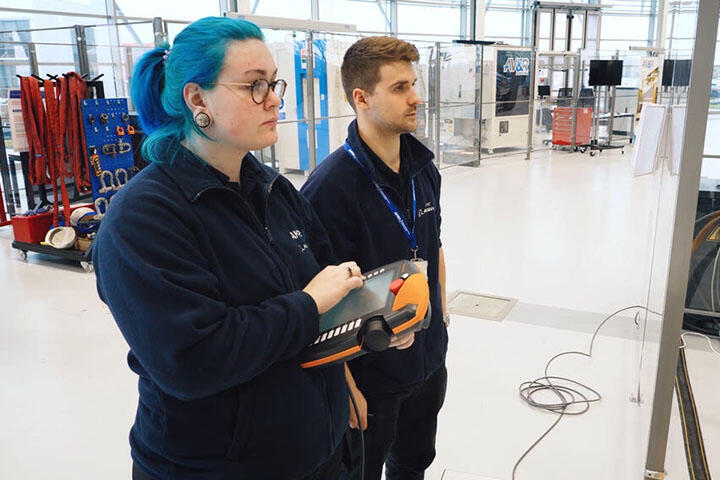
Once a teenage tearaway working in a chip shop, Rebecca Wright has steered her career to the pinnacle of motorsport inspecting Formula 1 cars. It's a career-defining journey she credits to the University of Sheffield AMRC, where the lessons she learnt redirected her focus to engineering.
Sitting back in the AMRC’s flagship Factory 2050 facility where her engineering career first started, Rebecca, now 27, talks about her life before her transformational career turnaround, building her skills at the AMRC and working in F1.
Overcoming the odds
Labelling herself a ‘teenage tearaway’, Rebecca was once told by teachers she would never succeed because of her colourful hair and piercings.
The feedback knocked her confidence, prompting her to hide her true self.
"I had quite an attitude at school, but their words clearly had an impact," Rebecca said.
"When I went to job interviews, I took out my piercings, covered my tattoos with foundation and dyed my hair a 'normal' colour.
“I bounced through jobs at a chip shop, Primark, a call centre, and a charity — lost and unsure of where I was going."
Her turning point came when she applied to the University of Sheffield AMRC Training Centre for an engineering apprenticeship. Joining the programme turned her life around, which has since led her to a dream career in F1.
"Now, I know I can excel at my job while being fully myself," she said. "It doesn't matter how I look, everyone at the AMRC and in F1 has been incredibly welcoming."
The turnaround at Factory 2050
While undertaking her apprenticeship, Rebecca was employed by the University of Sheffield AMRC’s Integrated Manufacturing Group at Factory 2050 – a place she credits with making her career.
"Looking back when I first walked in to the factory at the start of my career, I was so nervous and felt out of my depth, but it was so cool and futuristic”, Rebecca said
“It’s a good feeling being back at the AMRC. I love being here and miss it because I learnt so much and gained a lot of life skills.”
Her work spanned computer-aided design, 3D printing management and maintenance, even installing robots she still recognises today.
Under the guidance of mentor James Lindsay, she learned resilience.
"He pushed me to persevere when things got tough,” she said.
The AMRC brought me out of my shell. It was an environment where you could talk to people in any job role and learn from them, teaching me to ask for help instead of staying quiet.
The shift was dramatic for someone who struggled with anxiety as a child.
“When I was a little, my dad used to take me to a sandwich shop and he would ask me to order for myself and I remember getting really upset because I was so anxious,” she said.
Years later, Rebecca found herself on stage at an engineering conference speaking to a crowd, adding: "My parents were amazed, remembering the girl who was too scared to order her own food.
“The AMRC made me who I am today."
The fast lane of working in F1
Rebecca’s motorsport journey began three years ago, initially taking a night-shift role at a top F1 team.
Personal setbacks briefly forced her to step away, but when a daytime position opened at the same team, she seized the second chance.
"My boss knew my work ethic and gave me the job. It was an incredible moment," she said.
Today, her role involves meticulously inspecting composite car components, scanning structures and validating precision parts where millimeters make all the difference.
The payoff comes on race day: “One time we went trackside for practice and my boss and I just looked at each other like, 'Oh my god, we built this,'”she said.
“Seeing the car run on track gives me the same proud emotion parents feel watching their kids start school. It doesn't matter where we are in the championship; it's the fact that it's running.
“And bringing my dad, who is a massive F1 fan, to the British Grand Prix has been amazing. He roots for us now because it’s my team.”
Pride, legacy and the future
Rebecca is eager to inspire the next generation of engineers, particularly young women who might feel intimidated by a male-dominated industry.
“People often fear feeling underqualified, but my advice is simple: give it a go," Rebecca said.
"I applied for F1 thinking I wasn't skilled enough, but you build those skills by working hard and asking questions. If you’re willing to learn, you will fit in. It's nowhere near as intimidating as it looks from the outside."
As the AMRC celebrates a milestone 25th year, its anniversary message is clear: Made here, Made Better, Made for the future.
Rebecca credits the organisation with turning her life around.
"Before coming here, I was rebellious and lacked direction. The AMRC was where I grew up and focused," she said.
"They were patient with me and gave me a chance. The person I was before isn't who I am today and is someone I could never be again. This place shaped me.
“I wasn’t just made anywhere; I was made at the AMRC.”