


How AMRC's COMPASS facility will help clear a global aircraft backlog
Published: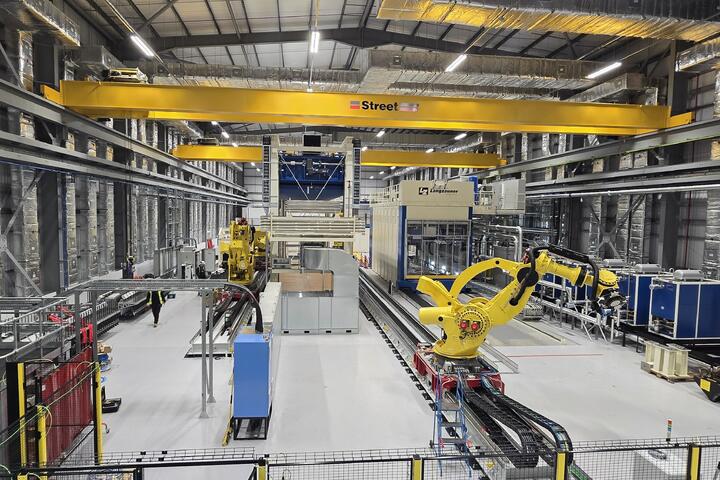
By Stephen Beecher, senior sector engagement manager for aerospace at the University of Sheffield Advanced Manufacturing Research Centre (AMRC).
Engineering has always been defined by the pursuit of the impossible. Today, that impossibility is a maths problem: clear a global aircraft backlog of tens of thousands while meeting a non-negotiable mandate for net-zero flight.
Solving this requires more than just better design. It demands a fundamental shift from manual craftsmanship to high-rate, industrialised automation and digital integration.
In 2023, the University of Sheffield AMRC set out a vision to solve this equation. Announced as a cornerstone of the UK’s first Investment Zone, the Composites at Speed and Scale (COMPASS) programme was conceived to de-risk and accelerate the manufacture of large-scale composite parts. Today, that vision has shifted from blueprints and construction dust into a 2,700m² research and development (R&D) reality.
In a landscape now shaped by the government’s new Industrial Strategy that champions advanced manufacturing as national priority, the COMPASS facility is fully built, its state-of-the-art equipment funded by the Aerospace Technology Institute is live and the first user is commissioned: home to Boeing’s largest global research project.
As we prepare for the official opening this year, COMPASS stands as a milestone for UK aerospace sovereignty – a world-class, open-access asset capable of meeting modern demand with right-first-time precision.
Precision at scale, every single time
In an industry where narrow-body production rates must jump from 30 shipsets a month to 100, traditional manual layup is a bottleneck we can no longer afford. COMPASS bridges this gap by combining the AMRC’s expertise in composites and digital manufacturing.
The goal? Reducing process times for large-scale components from 40 hours to four, ensuring the hundredth part is as precise as the first. By proving these high-rate methods at technology readiness level six, we are ensuring the next generation of aircraft isn't just designed in the UK, but manufactured here.
Behind the COMPASS doors
The scale of the facility is unprecedented, housing equipment funded by the Aerospace Technology Institute. At its heart sits the Langzauner’s Resin Transfer Moulding (RTM) press – the world’s largest for integral aerostructural parts – boasting a 2,400-tonne pressing force and tool size up to 10m x 3m. Adjacent to it is Zünd’s largest and most complex cutting table spanning 21.4m.
Two 5-metre Loop Technology FibreFORMs will ‘pick and place’ the delicate material. To accommodate the extensive reach required, they are mounted on two of FANUC’s largest robots, supported by three additional FANUC robots within the cell. This fleet operates along an 85m track, using real-time sensor data to dynamically adjust to material behaviour during the build process.
Every element of the facility is geared toward this level of accuracy, right down to the floor itself, which was cast as a single slab to prevent expansion joints from impacting robot track alignment.
While the hardware provides the muscle, the intelligence of COMPASS provides the control and is a true differentiator. The facility is digitally native, moving the digital thread from theory into a functional tool.
By using digital twins, we can virtually commission a process before a single carbon fibre is laid, allowing for a right-first-time approach essential for high-rate production at large-scale.
An open-access playground
A common misconception is that such high-tier infrastructure is reserved for industry primes. On the contrary, COMPASS is a low-risk sandbox for the entire supply chain.
With such a broad technological suite, industry partners can engage with the AMRC to use COMPASS’ technologies on a part-process basis, accessing only the specific machines they need. This flexibility grants small and medium enterprises (SMEs) the same technological firepower as global leaders.
This accessibility extends to the digital realm. As our data pool grows, companies can interact with the facility’s data to validate their own processes and software within isolated cells. By removing the need for heavy capital investment, COMPASS allows the wider supply chain to plug into the future of aerospace without prohibitive entry costs. It is a near production facility available to all.
A strategic anchor for clean flight
The strategic weight of COMPASS was underscored earlier this year when the Chancellor of the Exchequer, Rt Hon Rachel Reeves, visited the facility – highlighting how the programme’s ambitions align with the UK’s Modern Industrial Strategy.
Sustainability is not an add-on; it is a competitive necessity. COMPASS directly supports FlyZero, the UK government-backed programme exploring zero-carbon emission air travel. By moving to automated closed-moulding, we are changing the shop-floor economics of sustainability. These processes drastically reduce material scrap, reduce downstream processes and eliminate many of the energy-intensive consumables found in traditional builds.
What began as a seed in 2023 has blossomed into one of the nation’s most significant industrial regeneration projects. This isn't just about R&D. It is the heart of a green aviation cluster in South Yorkshire.
By fusing advanced manufacturing with the urgent requirements of sustainable aviation, we are securing the UK’s position as a global leader in the future of aerospace, while unlocking multi-billion pound export opportunities and securing in the UK high-skilled jobs for decades to come.
As we look toward the grand opening, our message to the UK manufacturing sector is simple: the machines are live, the data is flowing and the blueprint for the next century of aerospace is ready.
COMPASS is no longer a project of the future; it is where the future of manufacturing is being delivered today.