


Sharpening the eyes of small satellites using additive manufacturing
Published: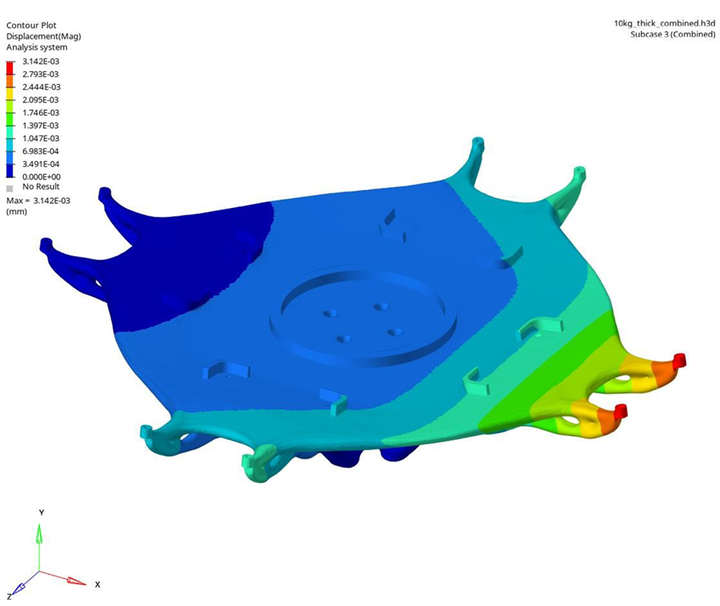
A team of additive manufacturing and design engineers at the University of Sheffield AMRC has pushed the boundaries of small satellite capability through new research into AM and advanced design techniques.
A team of additive manufacturing and design engineers at the University of Sheffield AMRC have published a research paper looking at advanced 3D-printing and smart design algorithms to develop ultra-stable tools required to create high-resolution, deployable mirrors for small satellites.
The paper, ‘Topology optimisation of a single-point diamond-turning fixture for a deployable primary mirror telescope’, explores how ultra-stable tooling for single-point diamond turning can be developed using topology optimisation to manufacture high-precision, deployable mirrors.
Satellite mirrors
The mirrors are engineered to remain compact during launch and deploy once in orbit — overcoming the physical size constraints that currently limit small, low-cost satellites, such as CubeSats, from carrying the large-aperture optical systems needed for high-resolution Earth observation.
One of the biggest challenges facing small satellites is size. Traditional telescope mirrors are too large to fit within the tight constraints of these platforms. The research tackles this by enabling mirrors that can be folded during launch and deployed once in orbit.
Topology optimisation
By using topology optimisation, researchers designed a fixture that removes all unnecessary material, resulting in a complex, bone-like structure that is both extremely lightweight and highly rigid. Such intricate geometries would be impossible to produce using conventional manufacturing methods — but AM makes them achievable.
The results from the research are significant:
- A 68 per cent reduction in weight compared to traditional fixtures
- Up to 86 per cent reduction in undesired movement, improving machining precision
- Enhanced stability for producing ultra-precise optical components
The breakthrough
By combining smart design algorithms with AM, the team has created a more efficient and cost-effective way to manufacture the high-precision mirrors required for space-based imaging systems.
This breakthrough paves the way for smaller, lower-cost satellites to carry powerful telescopes — unlocking new possibilities for Earth observation, environmental monitoring, and global data collection.
Learn more about our work in additive manufacturing.