


AMRC supports emerging polymorphic manufacturing technology
Published: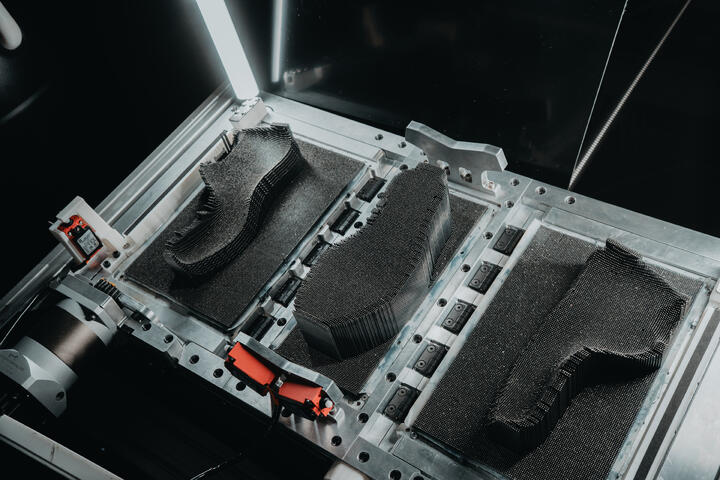
A pioneering Sheffield start-up has called on the expertise of additive manufacturing researchers at the AMRC to help bring a new shape-shifting polymorphic tooling technology to the factory floor — a breakthrough the company says will prompt a 'fundamental shift' for industry.
Fyous, an advanced manufacturing technology company, is pioneering polymorphic manufacturing machines, a new production paradigm that can allow manufacturers to produce bespoke parts at near-mass-production prices using 3D computer-aided design (CAD) models and reconfigurable tooling systems.
Featuring tens of thousands of precisely controlled pins that reconfigure to create temporary tools in minutes, polymorphic machines can function as injection moulds, forming tools and work-holding fixtures. By eliminating the need for fixed tooling, which often takes months to deliver and accounts for up to 98 per cent of part costs at low to medium production volumes, these machines support rapid prototyping and more economical production of bespoke products.
Joshua Shires, chief executive officer of Fyous, said: “Polymorphic manufacturing is a fundamental change in production capability that delivers the agility of additive manufacturing with the quality, scalability and throughput associated with high-volume processes.
“This foundational shift in manufacturing technology represents the dawn of a new manufacturing category, making it possible to produce high volumes of unique, one-of-a-kind items as quickly and profitably as traditional mass-produced batch processes.”
The University of Sheffield AMRC’s additive manufacturing (AM) team has been working with a number of its partners on a workholding project, which looked at the feasibility of two holding systems - reconfigurable digitally controlled pins and light-activated adhesive based - focusing on the machining applications of additively manufactured components for the aerospace sector based on industrial need.
Prompted by partner interest in the start-up's new workholding methodology, the AMRC team worked with Fyous to assess its viability. This project resulted in a detailed feasibility report, outlining a number of advantages and constraints of the emerging technology.
Joshua added: “Working with the AMRC has helped further validate use cases for polymorphic moulding. Their technical expertise and facilities allowed us to assess the process in a real engineering context, giving us confidence that the technology is suitable for advanced, precision-led manufacturing applications.”
Ben Morgan, chief executive officer of the AMRC, said: “Following our first experience with polymorphic manufacturing for our workholding project, the far-reaching potential of this technology became clear. It offers a practical new route to fast, flexible manufacturing, and we’re excited to explore how it can be applied across a wide range of industries.”
Fyous has outlined how polymorphic manufacturing technology addresses the tooling bottlenecks that hinder both traditional injection moulding and industrial-scale 3D printing in a new whitepaper which can be read here.