


Revolutionising cutting performance with additive manufacturing
Published: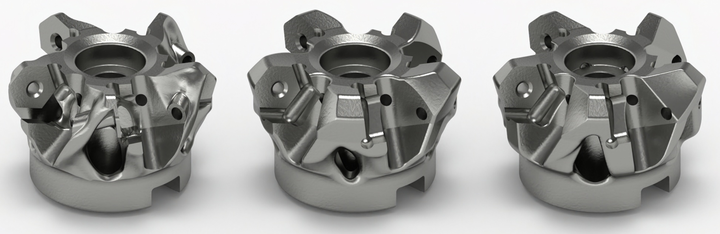
New research and innovation from additive manufacturing engineers at the AMRC, as featured as the cover story in Metals, demonstrated how topology optimisation and metallic AM can transform one of the subtractive manufacturing’s most critical tools: the cutting tool.
The paper, ‘Optimised and additively manufactured face mills for enhanced cutting performance’, combines a smarter design process realised via laser powder bed fusion to redesign cutting tools from the ground up, reducing vibration while maintaining the stiffness required to withstand extreme cutting forces.
To validate the approach, the team manufactured and tested different variations of the cutting tool under demanding conditions while cutting through titanium Ti6Al4V.
Research results highlight clear performance advantages
- Reduced vibration: topology-optimised designs significantly lowered vibration, improving cutting stability and precision.
- Minimal wear: the optimised tool showed negligible damage (just 100 µm of tool wear), proving it can survive extreme conditions.
- Consistent performance: improved stability enabled better surface quality and longer tool life.
The impact of topology optimisation
The impact this research concludes is that complex cutting tools or tool holders printed via AM technologies aren't just a fancy experiment — they are a smarter and a more efficient way to manufacture.
By adopting these optimised tool designs, factories can:
- Reduce costs: longer tool life lowers replacement frequency.
- Minimise downtime: less tools to change.
- Increase productivity: improved performance enables faster machining of advanced materials.
Talk to us about how we can support your business with additive manufacturing.